FAITH IN WATER
  • Home
  • Who we are
    • Our history
    • Faith-based ESD Toolkit
    • WASH in Schools mapping
    • Putting Clean Hands Together
  • What we do
    • Dignity for Girls >
      • D4G schools
    • Our approach
    • Case studies >
      • Faith-based WASH in Indonesia
      • Ebukoola Primary School
      • Gisire Academy
      • Star of the Sea
  • The issues
    • Water
    • Sanitation
    • Hygiene
    • Impact on girls
    • Sustainable solutions
    • Sustainable Development Goals
  • Working with faiths
    • Faith schools
  • News & resources
    • Faith in action
    • Toolkits and downloads
    • Prayer resources
    • Dates for your diary
  • Support us
    • Reporting concerns
    • Contact us

Faith in Water takes part in the MHM conference, New York

30/9/2016

 
Picture
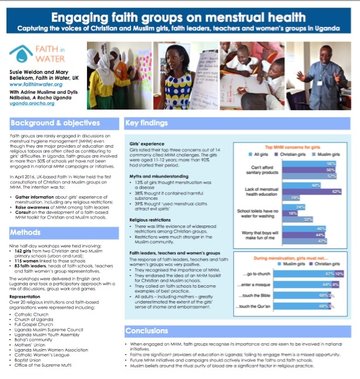
Faith in Water was delighted to take part in both the Menstrual Hygiene Management (MHM) conference, convened by UNICEF and Columbia University in New York this month, and the MHM in Ten meeting the following day. 

As well as having a poster submission accepted for the MHM conference we also attended the event in person; hundreds more people from around the world took part in the live virtual conference. 

You can find our poster, which outlined our engagement of faith schools and faith leaders in Uganda earlier this year, on the WASH in Schools' Mapping website here. 

We also attended the next day's MHM in Ten meeting to look at how to advance the MHM agenda in schools. Both days were engaging, challenging and uplifting. While there is much to be achieved in moving forward the MHM agenda, it was inspiring to hear of all the initiatives, studies and campaigns launched in this area. Faith in Water is playing its part by engaging faith groups to view menstrual health as critical for girls' health, education and wellbeing.

** UPDATE: MHM in Ten report out **

The report of the third MHM in Ten meeting, held in October 2016, has been released. Read the full report: MHM in Ten: Advancing the MHM Agenda in Schools. 
The difficulty of changing behaviour: no quick fix, say experts

30/9/2016

 
Picture
It's one of the biggest challenges facing anyone working in water and sanitation. No matter how many toilets or hand washing stations you build, they will be a monumental waste of money if people don't use them. 

India is trying to grapple with this problem. It has more open defecators than any other country in the world. Over the last few decades the government has implemented national programmes to change this, including the Swachh Bharat Mission (SBM), a national programme launched in 2014 with the aim of eliminating open defecation by 2019.

However, the demand for sanitation – i.e. a genuine demand for toilets and actual use of those toilets – has not been encouraging.

​In September, a number of experts met in Delhi to discuss the reasons for this and what can be done to bring about lasting behaviour change. For a longer report of the meeting, visit the article on Sanitation Updates. However, here are a few key lessons.
  • It is just as important to understand what doesn’t work, as well as to understand what behaviour change interventions do work.
  • Actual change in behaviour and practice in communities takes time. Interventions have to be designed to be delivered over a longer time with relevant and progressive messaging.
  • Put communities first. Every community is different. Make sure you understand their context.
  • The lack of land tenure security, cramped and smelly toilets can affect the adoption of hygienic behaviour.
  • Low aspirations and negative self-perception, reinforced by sanitation campaigns focusing on shame and disgust, may discourage the poor to construct toilets.  
  • Actions that reinforce communities’ pride in their way of life and cultural habits make them more open towards behaviour change messages.
  • Another positive trigger is exposure to properly designed, well-functioning and clean toilet facilities in health care facilities, schools, bus/train stations etc. Toilets are more likely to be used if there is good light, space and ventilation, easy access to water and simple pit cleaning technology. 
  • Children have a key role to play in behaviour change. Dettol's Swachhata Ki Paathshala campaign incorporates sanitation messaging into the school curriculum in different regional languages. 
  • Faith-based leaders have been instrumental in influencing a large section of the community to adopt hygienic behaviour and toilets, according to the Global Interfaith WASH Alliance; 99% of Indians belong to a faith. The Alliance plans to start a ‘Swachhata Kranti’ (Clean Revolution).
  • Targeting only women will not solve India’s sanitation problems. The focus should be all household members, including men.

Nicest Job in Britain chooses Faith in Water for its philanthropy programme

4/8/2016

 
Picture
We are delighted to announce that The Nicest Job in Britain has chosen Faith in Water for its annual philanthropy programme. This is a nationwide initiative designed to help 40 charities in the UK – and Faith in Water is incredibly honoured to have been chosen out of hundreds of applications.

The Nicest Job has built a showcase platform for Britain's charities, demonstrating the great people that work for them, the environments they operate in and the challenges they face.

We're really excited about the prospect of hosting the National Philanthropy Manager and the chance to get a fresh perspective on what we're doing as well as some great publicity about our work.

Thank you for choosing us, Nicest Job!

Lack of money and education, fear of stigma: girls' menstrual health problems

13/7/2016

 
Picture
When it comes to dealing with their periods, the three biggest concerns for girls in Uganda are: 'Can't afford sanitary products'; 'Fear that boys will make fun of me'; and 'Lack of menstrual health education'. But the state of school toilets was also a major issue, with 62% of girls questioned saying they were too dirty, too crowded and lacked water for washing.
 
These are some of the results of Faith in Water's consultations on menstrual health with faith groups in Uganda. Although the Ugandan government and other NGOs have been working to push menstrual hygiene management higher up the agenda for schools, this is the first time that faith groups have been engaged on this issue.
 
Faith in Water is developing a toolkit for faith schools on how to help girls manage menstruation safely and with dignity – important given the mounting research that shows girls often miss school during their periods, with potentially devastating impact on their education and future life chances.
 
We held nine workshops in April 2016 to find out what girls' and schools' challenges were, and to discuss the importance of good menstrual health teaching to girls' education. We were delighted with the response from faith leaders, faith women's groups, heads and teachers of faith schools, who all agreed this was a serious issue that needed to be taken seriously by faith groups (who are involved in over half of schools in Uganda).
 
As Rev Canon Diana Nkesiga said it was time to let go of outdated ideas about stigma and shame: 'Church schools should be exemplary places of teaching dignity and hygiene.' 
 
Balinda Sirag, of the Uganda Muslim Youth Assembly, said: 'Before I got involved, I used to think this issue is not important. Now I know it is very, very important. We must break the silence on menstruation and keep girls in school.'
 
We were also delighted by the response of Angela Nakafeero, Gender Techical Adviser with the Ministry of Education, Science, Technology and Sports, who said of Faith in Water's planned toolkit for faith schools: 'We are looking forward to this toolkit for religious schools. It is very exciting for us. We feel that this contribution will complement some of our interventions.'
 
To read the full report, including findings of girls' experiences of menstruation and challenges facing schools, download it here.


Cleanliness is next to godliness? Not in India, it seems

12/7/2016

 
Picture
Indians spend more on religious services than on sanitation, regardless of spatial and income divide, according to a recent report by the National Sample Survey Organisation (NSSO).

The recently released report gives a break-up of spending on 14 consumer services between July 2014 and June 2015. These ranged from barber and beauty shops to domestic services, as well as TV and radio services, laundry and dry cleaning. 

The study found that religious services accounted for almost 9% of the total monthly per capita spending (on consumer services) in rural areas, compared to 0.22% spent on sewage disposal and sanitation. The figures for urban India were 5.7% on religious services and 0.45% on sanitation. 

Expenses on sewage and sanitation include any amount paid to toilet cleaners, sewerage cleaners and waste water treatment plants. Religious services, on the other hand, include priest charges, religious donations and subscriptions and other religious expenditure.

Poorer Indians and rural Indians spent proportionally more on religious services. The poorest 20% of people in rural areas spent 7% of their consumer expenditure on religious activities, compared to the almost 10% for the richest 20%. 

And while more than one in three households in both rural and urban India reported consuming religious services, only one in 50 rural households and one in 10 urban households reported sewage disposal and sanitation services.

For more information, see this article on the NSSO report in LiveMint E-Paper. 

World Water Day on March 22 is a time to reflect on challenges and successes

22/3/2016

 
Picture
We've been celebrating March 22 as World Water Day since in 1993. And in that time, the world has notched up some notable successes.

For example, nearly 2.6 billion people have gained access to clean water. But with so many people (663 million) still without access to clean water, there is no room for complacency.  National Geographic has produced a useful graphic showing who has access and where. 

In a thought provoking article, World Resources Institute gave reasons for alarm and hope about the global water future. Among the alarms were the food crises in Africa over the last year, where several counties suffered their worst drought-related food shortages in more than a decade. They have left one million children in southern and eastern Africa suffering from severe malnutrition, and 2.5 million people across southern Africa in crisis stages of food insecurity.

Among the reasons to be hopeful was the international adoption of two remarkable agreements: the new UN Sustainable Development Goals (SDGs) and the Paris Climate Agreement, which offer opportunities for better water management that will benefit millions. Click here for the full article. 

The World Economic Forum ranks water crises as a top long-term risk

3/2/2016

 
Picture
The World Economic Forum, whose membership includes heads of state, CEOs, and civic leaders, has ranked water crises as the top global risk to industry and society over the next decade in its 11th edition of the Global Risks Report, published this week.

Last year, water crises earned the top spot as the most damaging short-term risk. Along with water’s rise in the Paris climate talks, the rankings indicate that water is now an urgent political matter, says the website Circle of Blue which focuses on water issues. It has published a thought-provoking article looking at how water has risen up the priority list, partly because environmental stress, worsened a by warming planet and a growing population, is leading to greater tension over scarce land, food and water. You can read it here.

Could a couple of tins of paint be the key to getting kids to wash their hands? 

29/1/2016

 
Picture
Getting people to change their behaviour is very hard. Which is why we are feeling very excited by this latest study using 'nudge' techniques to get pupils to wash their hands after using the toilet.

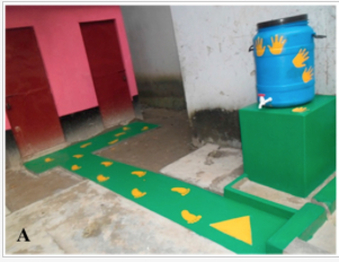
It's so simple that you almost can't believe how powerful it could be. Basically, the researchers painted a path, complete with bright yellow footprints, from the latrines to the hand washing point. This was painted bright blue with yellow hand prints and had been raised on top of a concrete block to be the right height to make it easy for the primary school children (in Bangladesh) to use.

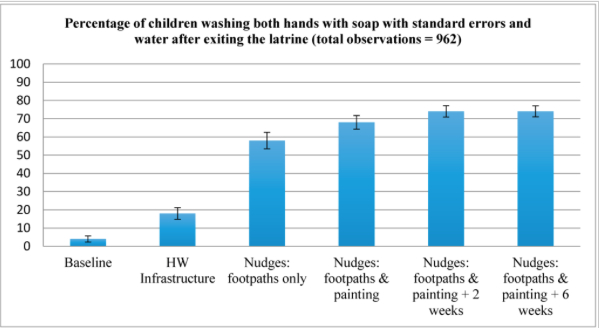
Then they made sure there was soap available, and sat back and watched what happened. There were no lessons or reminders to the children of the importance of washing their hands. And the results were amazing! You can see, from the graphic below, that just 4% of children were observed washing their hands with soap before the experiment. But two weeks after painting, 74% of children were washing their hands with soap - and six weeks later, that figure remained true. The study was carried out by the University of Oklahoma's Centre for Applied Social Research, with Save the Children and the University of Buffalo. You can read about it here.

Picture

Ever wondered how to make a tippy tap? This video shows you how.

14/12/2015

 
Hand washing with soap could prevent half of child deaths from diseases caused by dirty water and unsafe sanitation.

​This great video by Watershed Management Group shows how to make a tippy tap: a simple tool that enables people to wash their hands without contaminating what they touch.

Access to water and basic sanitation are a human right: Pope Francis in Kenya

27/11/2015

 
Picture
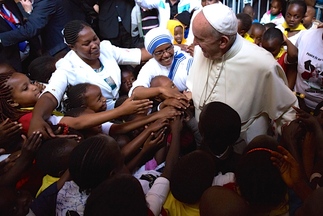
On the final day of his visit to Kenya, Pope Francis visited Kangemi slum in Nairobi where he called for access to basic but vital services, especially water and sanitation.

He told his audience: "Access to safe drinkable water is a basic and universal human right, since it is essential to human survival.... To deny a family water, under any bureaucratic pretext whatsoever, is a great injustice, especially when one profits from this need." 

​People needed access to infrastructures and basic services, he said: "By this I mean toilets, sewers, drains, refuse collection, electricity, roads, as well as schools, hospitals, recreational and sport centres, studios and workshops for artists and craftsmen." 


He ended his address: "Dear neighbours, dear brothers and sisters, let us together pray, work and commit ourselves to ensuring that every family has dignified housing, access to drinking water, a toilet, reliable sources of energy for lighting, cooking and improving their homes; that every neighbourhood has streets, squares, schools, hospitals, areas for sport, recreation and art; that basic services are provided to each of you; that your appeals and your pleas for greater opportunity can be heard; that all can enjoy the peace and security which they rightfully deserve on the basis of their infinite human dignity." 

​Read the full text of his address here. (Photograph courtesy of CAFOD.)

<<Previous
Forward>>

    Updates

    Read the latest news of Faith in Water's activities as well as interesting stories on WASH around the world.

    Archives

    March 2021
    July 2020
    January 2020
    July 2019
    June 2019
    May 2019
    June 2018
    January 2018
    December 2017
    November 2017
    October 2017
    September 2017
    August 2017
    May 2017
    March 2017
    February 2017
    September 2016
    August 2016
    July 2016
    March 2016
    February 2016
    January 2016
    December 2015
    November 2015
    October 2015

    Categories

    All
    Children
    Philippines
    Sanitation
    Toilets
    UNICEF

    RSS Feed


    Main photograph above by IFPRI (International Food Policy Research Institute)

    Faith in action

    We're naturally interested in stories of faith in action, particularly those that show the impact of working with faith groups. Our faith in action page has a collection of stories and links to explore further.
    Read more

    Prayer resources

    We collect prayer and meditation resources on water and cleanliness for use by faith groups. 
    Read more

Picture
Registered Charity no: 1164290
​

About faith in Water

Our aims
Our history
Our approach
Our impact
Latest news
Resources
Contact
Reporting concerns/ Safeguarding


What we do

The issues
Water
Sanitation
Hygiene
​
Dignity for Girls
Sustainable solutions
Sustainable Development Goals
​

Contact us

Faith in Water
Flat 16, Summerhill Court 
31 Summerhill Road 
Bristol 
BS5 8HG
Tel: +44 797 0466 830
Email: [email protected]
Skype: FaithinwaterBristol
Twitter: @FaithinWater

​Sign up to our quarterly newsletter here.

DONATE
You can support Faith in Water's work by clicking the PayPal button above or by going to our Support us page. Thank you!  

Tweets by Faith_in_Water